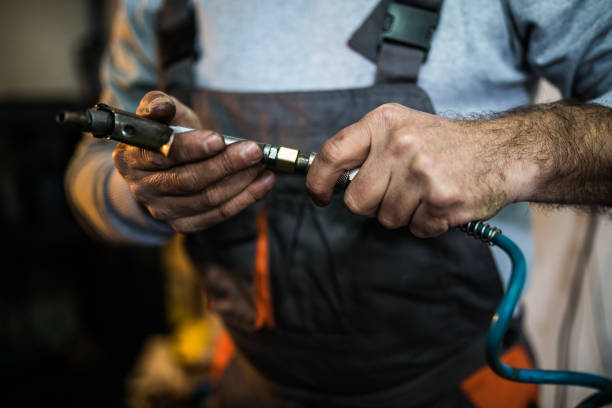
Understanding Your Air Demand
The most common and costly mistake businesses make when purchasing a compressor is buying based on motor power alone. What actually matters is your required airflow (measured in m³/min or cfm) and working pressure (bar or psi).
Before speaking to any supplier, calculate your total air demand by listing every pneumatic tool and process that will run simultaneously this gives you your peak demand. Then consider how often each tool actually runs this gives you your average demand.
Key Selection Criteria
1. Required Flow Rate (m³/min)
Add up the consumption of all tools that may run at the same time. Add a 25% safety margin for future expansion. This is your minimum required FAD (Free Air Delivery).
2. Working Pressure (bar)
Most workshop tools require 6-7 bar. Specialist processes like plasma cutting or sandblasting may need 10-17 bar. Always select a compressor rated for 1-2 bar above your required working pressure.
3. Duty Cycle
Reciprocating compressors are typically rated for 50-75% duty cycle they need rest time. Rotary screw compressors can run 100% duty cycle, making them ideal for continuous production environments.
Fixed Speed vs Variable Speed Drive (VSD)
If your air demand varies significantly throughout the day, a VSD compressor can reduce energy consumption by 30-50% compared to a fixed-speed unit. The higher upfront cost is typically recovered within 18-24 months through energy savings.